

Large rug under the bed
It creates a common base around the bed. Be sure to leave enough surface area visible on the sides and at the foot so the rug retains practical value.


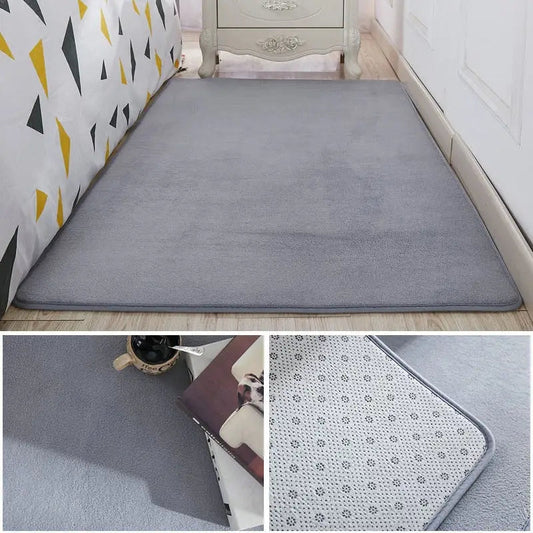


A bedroom rug should make the areas where you actually walk more pleasant without obstructing furniture or doors. It can surround the bed, remain visible at the foot, serve as a bedside runner, or define a reading nook. The right choice therefore depends on the bed frame, bedside tables, cupboards, circulation, and the level of maintenance you desire.
There is no single correct layout. The goal is to create a visible and useful surface where you get out of bed, get dressed, or walk around. A large rug can go under the bed, two narrower formats can serve as bedside runners, and an independent model can create a reading zone.
It creates a common base around the bed. Be sure to leave enough surface area visible on the sides and at the foot so the rug retains practical value.
The rug starts after the nightstands and extends to the sides and foot. This solution requires less surface area while remaining very legible.
Two runners offer comfort on each side and work well when the room is narrow or the bed takes up a large part of the width.
The rug becomes more of a compositional element. Leave it visible enough to avoid the impression that it is accidentally stuck under the furniture.
Practical if one side of the bed is against a wall or used by only one person. The placement can be intentionally off-center.
An independent rug can group an armchair, lamp, and small table together to create a true secondary function in the bedroom.
For a small rug placed directly in the area where you get out of bed, pay special attention to stability. On a smooth floor, a suitable underlay can be useful if the rug's backing is not sufficient.
Measure the bed frame, not just the mattress. An upholstered bed or a wide structure can add several centimeters on each side. Nightstands, dressers, benches, and closets also change the available area.
| Configuration | What to measure | Useful question |
|---|---|---|
| Large rug under the bed | Bed frame + useful overlap around it. | Does the rug remain accessible enough when getting up? |
| Lower part | Bed width + desired depth at the foot. | Does the rug remain visible without going under the nightstands? |
| Bedside runner | Length actually usable on the side. | Does a door or piece of furniture cross this zone? |
| Reading nook | Armchair, table, and circulation. | Does the rug connect the elements or float alone? |

With a single bed, a small side rug may suffice; a larger format can also create a play or reading zone. With a double bed, the rug often serves to visually bring the bed and nightstands together. The more imposing the frame, the more you must check that the rug does not disappear under the furniture.
For a king-size bed or a very wide headboard, an overly narrow rug may leave only two visible strips. In this case, a more generous format or two independent bedside runners may be more consistent. With a storage bed, consider your position when you open the base; with a bench at the foot, decide whether it should rest on the rug or remain on the floor.
Beds on legs show more of the pattern and texture. Very low structures hide a larger part of the surface: in that case, choose a rug whose visible areas remain interesting.
In a small bedroom, covering the whole floor is not necessary. A bedside runner or a rug partially placed under the bed can be enough while leaving passageways clear. In a large bedroom, a large rug can instead anchor the bed and prevent it from appearing isolated in the center of the room.
If the bedroom has a dressing area, office, or vanity, leave the areas where chairs, drawers, and doors move often clear. In an open-plan suite, a bedroom rug can mark the sleeping area across from an office or relaxation corner without adding a partition.
For a guest room, an easy-to-vacuum surface and a versatile color are often simpler than a very delicate rug. For a bedroom used as a daily office, the thickness under the chair and ease of movement also become important.
The bedroom allows you to prioritize touch over an entryway or kitchen, but the thickest rug is not necessarily the most suitable. Look at the height of the doors, vacuuming, the possible presence of pets, and the desired comfort when getting up.
Easy to fit under furniture and generally quick to vacuum. Interesting if the room also serves as an office.
A shaggy rug provides more volume and softness, with a more demanding vacuuming routine.
Jute or rush give a firmer, more textured finish. They should not be chosen solely for an idea of softness or ecology.
A machine-washable rug can simplify certain cleanings, if the format and instructions are compatible with your washing machine.
The composition alone does not allow one to claim that a rug is hypoallergenic, stain-resistant, or particularly suitable for children. These properties must be documented specifically.
Look at the rug with the elements that change little: floor, headboard, curtains, and walls. Bedding changes more often. It is therefore useless to seek an exact match with a particular set. A neighboring or complementary shade offers more flexibility.
A beige rug creates a soft base with white, ecru, or terracotta linens. A green rug and a blue rug provide a calm but more present color. A pink rug can range from a discreet powder to a brighter shade. Black and white is suitable when you are looking for graphic contrast.
A dark rug is not forbidden in a small bedroom. The effect depends mainly on the contrast with the floor, the light, and the rest of the palette. Similarly, a light rug does not mechanically make the room bigger; it simply creates a different visual break.

Yes. The round rug is particularly useful for creating a distinct zone: a reading nook, vanity, small office, or free space at the foot of the bed. It can also replace a classic bedside runner.
If the round rug goes partially under the bed, keep a significant part of the circle visible. When almost the entire shape disappears, the interest of the round shape is lost. Therefore, measure the diameter from the visible area rather than the total area of the bedroom.
For a firmer and more natural texture, the round jute rug collection can be relevant in a dry bedroom or an armchair corner, provided that this touch matches your expectation.
A child's bedroom often combines sleep, play, reading, and storage. Stability, maintenance, and available floor space therefore become important. A rug that is too large can interfere with storage furniture; a small, unstable format in the play area can be less practical.
The children's rug collection brings together models designed around this world. For a car, figurine, or floor activity zone, also see play rugs. The child's tastes remain a better guide than rigid color rules.
Always check the actual product information before using terms like "safe," "hypoallergenic," or "non-toxic." A children's style does not constitute a certification.
Observe the length of the pile, the loops, and the fringes. A relatively short and dense surface can simplify hair removal. Some loops may be more sensitive to claws. Color can also play a role in visual maintenance: a shaded rug sometimes masks hair better between cleanings than a highly contrasting solid color.
If the pet sleeps in the bedroom, favor a routine that you can maintain. A very delicate or very thick rug can become a burden even if it is pleasant under the feet. Ease of cleaning is then as important a criterion as softness.
It depends on the heating system, the rug, and any underlay. Some manufacturers impose a maximum thermal resistance or advise against certain combinations. Therefore, do not assume that a thin rug is automatically compatible.
Check the underfloor heating recommendations and product information. If you add a rug pad, its thermal contribution is added to that of the rug. In case of doubt, follow the limits provided by the system manufacturer rather than a general rule found for another type of installation.
In a bedroom, dust, hair, and textile fibers generally constitute the bulk of maintenance. Vacuum regularly with a method adapted to the construction. For a shaggy rug, avoid an overly aggressive brush; for a vegetable fiber rug, limit moisture according to instructions.
Avoid universal recipes based on vinegar, baking soda, or steam without knowing the material. A method effective on one fiber can damage another construction.
The bed frame and nightstands change the actual proportions.
Keep enough surface visible to enjoy the comfort and the design.
A thick rug can prevent a door or drawer from functioning normally.
Comfort must remain compatible with your maintenance habits and doors.
Similar shades often create a more natural interior than a perfectly coordinated set.
Check the system, the rug, and any potential underlay.
No. It can start after the nightstands and cover more of the lower part of the bed. The right choice depends on the surface you actually want to use.
A bedside runner, a model partially under the bed, or a round rug in a specific zone can be more practical than a very large format.
The feel depends on the material, density, and pile height. A shaggy rug provides volume, but a shorter, denser pile can also be comfortable.
No. A color reference or a complementary shade allows you to change the linens more easily without unbalancing the bedroom.
Yes. Consider the light, the floor, and the walls rather than applying an absolute rule.
Yes, provided that a sufficient part of the circle remains visible and the diameter is proportional to the available area.
For more softness, explore shaggy rugs. For a different shape, discover round rugs and round jute rugs. For a contemporary style, check out modern rugs. Return to rugs to browse all pieces.

A rug not only transforms your space by adding a touch of elegance and style, but it also provides a feeling of warmth and comfort with every step.

Une assise bouclette possède déjà un relief fort. Choisissez un tapis qui équilibre sa texture, son volume et sa couleur avec des exemples précis du minimalisme aux motifs vintage.

Superposer un tapis et une moquette est possible dans certains cas. Découvrez comment examiner le support, limiter la surépaisseur et conserver un ensemble stable et facile à entretenir.

Le canapé blanc laisse une grande liberté au tapis. Voici comment choisir entre continuité claire, contraste brun, terracotta, olive et motifs sans rendre le salon froid.

Poils, épaisseur, franges, bords et serpillières : les critères à vérifier pour choisir un tapis adapté à votre robot aspirateur et tester son passage.