

Covered space
You can prioritize comfort and style, while still keeping an eye on humidity, wind, and ease of cleaning.


An outdoor rug must be chosen based on its actual exposure. On a covered balcony, under a pergola, or on a completely open terrace, the constraints are not the same. Rain, sun, wind, dust, water drainage, and drying capacity matter more than a simple lifestyle photo. A model placed outdoors must be explicitly intended for this use.
The level of exposure completely changes the priorities. A covered balcony generally provides better protection from direct rain. An open terrace can be exposed to water, several hours of sun, and more dust. Under a pergola, conditions depend on the cover and the orientation. So, start by observing your space before selecting a material.
You can prioritize comfort and style, while still keeping an eye on humidity, wind, and ease of cleaning.
Choose only an outdoor rug whose usage conditions match this exposure. Water must be able to drain around and underneath it.
A relatively flat surface generally makes it easier to move chairs and remove crumbs. Ensure there is enough overhang around the table.
A large rug can connect the sofa, armchairs, and coffee table just like in an indoor living room, without blocking traffic.
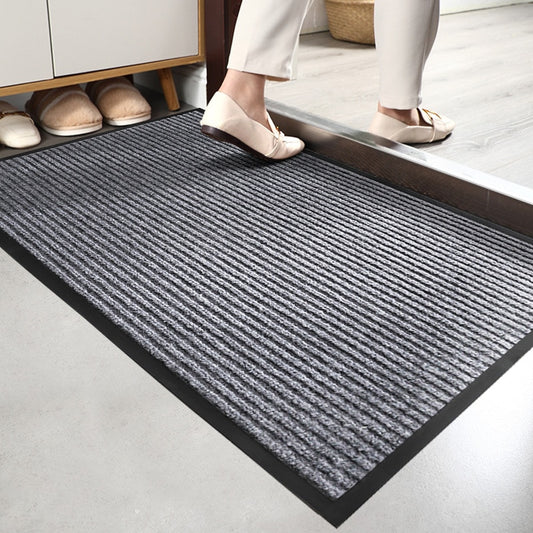
At the doorstep, the function changes. To wipe your soles before entering, use the outdoor doormat collection instead. This distinction prevents expecting a patio rug to perform the role of a doormat.

An outdoor rug structures a space just like an indoor one. Under garden furniture, it usually looks more cohesive when the main seating relates to its surface. Under a table, it must remain wide enough so that the chairs do not abruptly leave the rug when pushed back.
| Use | Sizing benchmark | Check to perform |
|---|---|---|
| Garden furniture | Connect sofa, armchairs, and coffee table. | Traffic paths, French doors, and furniture legs. |
| Outdoor table | Account for chair clearance. | Table in actual configuration and movement around it. |
| Small balcony | Complement the space without covering drains. | Threshold, drain, planters, and passage width. |
| Large terrace | Define a zone rather than covering the whole floor. | Transitions with other functions. |
Rugs intended for outdoor use often use synthetic fibers or flat-weave constructions, but the composition alone is not enough. Polyester or polypropylene is not automatically suitable for an open terrace. The weave, backing, dyes, and manufacturer's recommendations are just as important.
Natural fibers like jute or seagrass are generally associated with drier environments. Do not place a seagrass rug or a jute rug on an exposed terrace just because it looks natural. If you are looking for this aesthetic, choose a product where outdoor use is explicitly stated.
Often practical under a table or in a high-traffic area because furniture moves more easily on it.
Can add visual comfort, but sometimes traps more dust and requires more careful cleaning.
A construction that allows water to flow can be useful, but do not assume this property: check the product specifications.
There are visual styles inspired by natural fibers made from outdoor-ready materials. Rely on the stated usage rather than the appearance.
Not necessarily. Some models handle occasional moisture but must be able to dry properly; others are intended for sheltered areas. The label "outdoor" does not replace specific details regarding exposure. After heavy rain, check both the top and the underside of the rug.
If water remains trapped between the rug and the floor, lift it up—provided it is compatible with its maintenance requirements—to promote drying. Wooden, stone, tiled, or concrete floors may also require specific precautions when faced with prolonged damp coverage.
Avoid non-slip systems that prevent water circulation or are not intended for outdoor use. In an area where water regularly pools, fix the location or drainage issue first rather than treating the rug as a solution.
Prolonged exposure to light can alter the appearance of many materials. Even when a rug is designed for the outdoors, its visual durability depends on its manufacturing and the actual conditions. If specific UV resistance is important, look for this information explicitly on the product.
At the end of the season, a rug not designed to stay out all year should be cleaned, perfectly dried, and then stored in a dry place. Avoid rolling it up while wet: trapped moisture can create odors and degrade certain constructions.
In winter, repeated rain, frost, and damp storage are additional stressors. Follow the model's recommendations and do not assume that summer usage implies compatibility with all seasons.
Stability depends on weight, the backing, the floor surface, and the furniture. A rug placed under several sofa or table legs generally moves less than a small isolated format. On a smooth surface, a non-slip solution can be useful if it is designed for outdoor use and compatible with your flooring.
Do not create a fastening system that prevents drying or leaves residues on the tiles. In case of strong wind, a light rug may shift despite a proper installation; storing it temporarily may be safer than using improvised fasteners.
On a balcony, also ensure that the rug cannot lift in a dangerous manner. Furniture should not be used as the only "ballast" if its position becomes unstable.

In a dining area, think first about the movement of the chairs. A rug that is too small can create an edge exactly under the rear legs when someone sits down or gets up. Mock up the table and chairs in their extended position to choose a more realistic size.
Ease of cleaning also becomes important: crumbs, drinks, pollen, and dust are more common in this area. A relatively flat surface that can be vacuumed or brushed is generally simpler for daily maintenance. Check the permitted stain removal method before choosing a very light color if you eat outside often.
Table and chair legs must remain stable on the texture. A very uneven surface can be aesthetically pleasing but less practical with fine furniture. Daily use should guide the material choice as much as the style does.
Sand, beige, and gray tones blend easily with wood, stone, and outdoor furniture. Black and white provide a more striking graphic structure. Blue and green can create a subtle link with the vegetation or the sky without requiring an exact match.
If the furniture already features several materials—wood, metal, rope, printed cushions—a sober rug lets the overall look breathe. On a minimalist terrace, a bolder pattern can become the focal point. You can take inspiration from our designer rug or black and white rug collections, but only products explicitly marketed for outdoor use should be placed outside.
Colors also look different in full sun versus the shade. A dark shade might heat up more in the sun depending on the material; a light shade might make certain marks more visible. These factors should be weighed against the actual exposure.
Regularly remove leaves, pollen, sand, and dust. Abrasive particles can accumulate in the weave. Depending on the product, shake, vacuum, or brush it using a suitable method. A jet of water or detergent is not universally compatible.
An easy-to-maintain outdoor rug is, above all, a rug whose construction matches your routine. Do not choose a high-maintenance model if you know you won't have the possibility to move or dry it easily.
Compatibility with rain must be verified specifically.
The rug must not cover a drain or create a standing water area.
The weave, backing, and usage recommendations matter as much as the composition.
A very large format can become difficult to move, dry, or store off-season.
Regularly check the floor after rain or a damp cleaning session.
A beautiful photo on a terrace does not prove that the product is intended for this environment.
Not automatically. Outdoor usage and waterproofing are two different characteristics. Check the exposure conditions of the model.
Only if the manufacturer authorizes this use. Humidity, sun, and temperature variations can affect a rug designed for indoors.
Prioritize a stable, relatively flat surface that is large enough so that the chairs remain on the rug when pulled back.
Keep drains clear, check the underside after rain, and facilitate drying for both the rug and the flooring.
This depends on the product and the climate. If permanent exposure is not confirmed, clean, dry, and store the rug according to its instructions.
The former structures a patio or balcony area; the latter is placed at the threshold to treat dirt from shoes before entry.
For the threshold, check out our outdoor doormat collection. To compare all rugs by room, return to rugs. To work on your decor, also explore our designer rugs, beige rugs, and black and white rugs, always keeping outdoor use as a mandatory criterion.
A rug not only transforms your space by adding a touch of elegance and style, but it also provides a feeling of warmth and comfort with every step.

Une assise bouclette possède déjà un relief fort. Choisissez un tapis qui équilibre sa texture, son volume et sa couleur avec des exemples précis du minimalisme aux motifs vintage.

Superposer un tapis et une moquette est possible dans certains cas. Découvrez comment examiner le support, limiter la surépaisseur et conserver un ensemble stable et facile à entretenir.

Le canapé blanc laisse une grande liberté au tapis. Voici comment choisir entre continuité claire, contraste brun, terracotta, olive et motifs sans rendre le salon froid.

Poils, épaisseur, franges, bords et serpillières : les critères à vérifier pour choisir un tapis adapté à votre robot aspirateur et tester son passage.