


2024 Rug Trends: In Retrospect, What Really Lasted?
In 2024, several directions already dominated the rug universe: natural textures, geometric patterns, large formats, bolder colors, and a return to artisan-inspired styles. Two years later, some of these have held up well because they meet lasting needs—structuring a room, adding texture, warming a palette—while others were more of a passing fad.
1. The major rug trends of 2024 at a glance
| 2024 Trend | What it brought | In retrospect |
|---|---|---|
| Natural fibers and textures | Jute, wool, visible weaves, earthy tones | Very durable as a decorative language |
| Geometric patterns | Contrast and focal point | Still relevant if the pattern isn't too dated |
| Artisanal inspirations | Irregularity, inherited patterns, handmade effect | Remains strong, but requires more precision on true origin |
| Bold colors | The rug becomes a major piece | Very current when the palette is well integrated |
| Large format | Connects furniture and structures the room | More than a trend: a true rule of proportion |
| Scandinavian style | Neutrals, simplicity, comfort | Evolving towards more textured and less uniform interiors |
What stands out most today is that the trends that have aged best are those with a real decorative function. A correctly sized large rug or a natural texture does not depend on a single season.
2. Natural materials and visible textures: the most lasting trend
In 2024, rugs made of jute, wool, sisal, or with a deliberately visible weave were heavily promoted. The idea was less to seek a perfectly smooth surface than to introduce relief and a more tactile sensation.

This direction has aged well, but with an important nuance: natural does not automatically mean more durable, more ecological, or easier to maintain. Jute is sensitive to humidity, wool requires specific care, and the overall impact also depends on manufacturing and lifespan.
The right way to incorporate this trend today is to choose the material for its use: jute in a dry room, wool for comfort, flat weave when you want a surface that is easy to integrate under furniture.
3. Geometric patterns: a 2024 trend that greatly depends on the design
Lines, arches, checkerboards, abstract shapes, and geometric compositions held an important place. Their main advantage remains the same: immediately providing a visual structure to a neutral room.

In retrospect, it's not the geometric principle that ages, but certain patterns that are very recognizable from a specific period. For a durable purchase, opt for either a simple design or a pattern you truly love, rather than a code chosen merely because it's ubiquitous.
In an already busy room, keep curtains and large furniture more understated. Conversely, a geometric rug can liven up a beige, gray, or ecru sofa without needing to multiply accessories.
4. Artisanal inspirations: more authenticity, but beware of shortcuts
In 2024, so-called "ethnic," "Berber," or "Persian" rugs were very present in decor selections. The taste for irregular patterns, fringes, and traditional references was part of a search for character in contrast to overly standardized interiors.
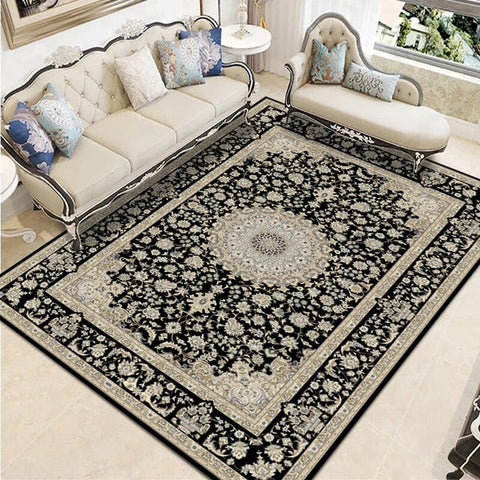
Hindsight allows us to better formulate this trend: a rug with a tradition-inspired pattern is not automatically artisanal. If origin or manufacturing matters to you, check the technique, country of manufacture, material, and seller's information.
Aesthetically, these patterns remain easy to integrate with wood, linen, solid sofas, and earthy palettes. Their strength comes less from the "ethnic" label than from the richness of the design and texture.
5. Color and texture: in 2024, the rug became more of a focal point
The rug was no longer just chosen in beige or gray to disappear under furniture. Bold colors, contrasts, velvet, and relief gained ground. This idea has particularly held up well: a rug can carry the main color of a room when other large surfaces remain calmer.
Earthy tones, greens, blues, and warm shades easily integrated into neutral interiors. Shaggy or looped textures reinforced the cozy effect, but their appeal always depends on the use: very long piles in a living room with pets or under a table require more maintenance.

The best legacy of this trend is therefore to choose a bold color or texture, not necessarily both to the maximum. This facilitates integration with the sofa, curtains, and walls.
6. Large rugs: a trend that has primarily become a matter of good proportions
Large formats were very visible in 2024 inspirations. In retrospect, this is probably one of the most solid trends because it addresses a real layout problem: a rug that is too small often fragments the living room.
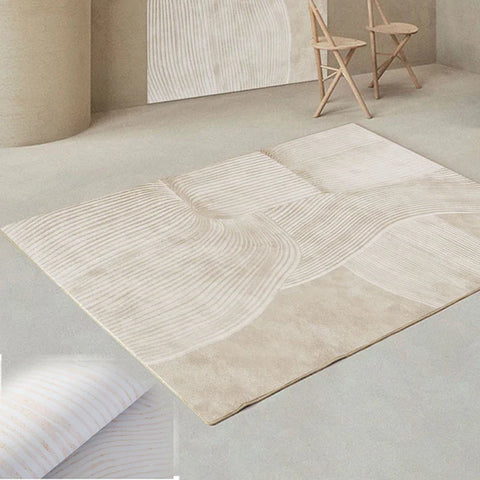
A rug large enough to extend under the front legs of the sofa and connect the armchairs creates a more cohesive area. In a dining room, it should allow chairs to remain on it when pulled back.
In other words, the "large trendy rug" has become a recommendation for proportion. Of course, it must be adapted to the room: the rug should not awkwardly bump against all the walls.
7. The Scandinavian style: still present, but less uniform
The 2024 Scandinavian style was based on neutral tones, simple patterns, light wood, and a sense of comfort. It remains easy to live with, but interiors have gradually gained texture, earthy colors, and more personal objects.

To avoid a dated result, don't try to reproduce an entirely gray, white, and light wood interior. Instead, keep the qualities of the style—simplicity, functionality, pleasant materials—then add a more personal color or an artisanal piece.
8. The outdoor rug: a lasting extension of decor
Outdoor rugs gained visibility because terraces and balconies are increasingly treated as real rooms. The principle remains relevant: a rug can define a dining area or a relaxation space without major work.
The essential condition is to choose a model explicitly designed for outdoor use. Do not infer its resistance to water or sun from its material alone. Check drying instructions and avoid stagnant moisture under the rug.
This trend has therefore aged well when conceived as a design solution, rather than a seasonal obligation.
9. Which 2024 trends are easiest to adopt today?
If you like a rug based on these 2024 codes, there is no reason for it to be replaced simply because the year has changed. Successful decor relies more on proportion, palette consistency, and use than on the date of a trend.
FAQ: 2024 Rug Trends
What rugs were trendy in 2024?
Selections at the time strongly highlighted natural textures, geometric patterns, artisanal inspirations, large formats, bolder colors, and revisited Scandinavian styles.
Are 2024 rug trends still current?
Some are, especially those that fulfill a lasting function: large format, textured materials, or rugs used as a focal point. For current trends, however, refer to the 2026 guide.
Does a 2024 geometric rug already look dated?
Not necessarily. Geometric shapes are ancient and reappear regularly. It's mainly certain very specific patterns or color combinations that can date more easily.
Should a rug that is no longer trendy be replaced?
No. If it is in good condition, well-sized, and consistent with your room, it remains relevant. Trends should not artificially shorten a rug's lifespan.
Where can I see current rug trends?
Consult our article dedicated to 2026 rug trends, which treats the current year separately from this archive.
Do you like one of the 2024 codes? Keep it if it suits your room: the right size and material matter more than the year of the pattern.
Discover living room rugsIn retrospect, 2024 primarily confirmed a lasting evolution: the rug moved from being a discreet accessory to a tool for structuring, texturing, and personalizing the room. The trends that have aged best are precisely those that improve the decor beyond a passing fad.