


What rug to choose with a dog or cat?
With a dog or cat, the easiest rug to live with is generally short-pile or flat-woven, sufficiently dense, stable on the floor, and compatible with quick spot cleaning. Avoid long, hard-to-vacuum fibers if your pet sheds a lot, and large, loose loops if your cat tends to scratch textile surfaces.
If your pet already has urinary accidents: first choose a rug whose material and backing you know precisely. Urine that soaks through to the backing or floor is much harder to treat than a small stain that remains on the surface.
1. The four criteria that matter before style
Start with your pet's actual behavior. A small dog that sheds little doesn't impose the same constraints as a large dog often returning from the garden. A cat that readily uses its scratching post doesn't stress the rug as much as a cat that prefers horizontal surfaces.
Then look at the pile height, fiber structure, actual washability, and rug backing. These four elements determine ease of use more than the simple name "pet-friendly rug."
2. Short pile, flat weave, or shaggy?
A short pile makes it easier to vacuum up pet hair, crumbs, and small debris. Flat weave offers even less depth for hair to get trapped.
Shaggy remains an option if you like its comfort, but it requires more vacuuming and can trap hair deep in the pile. Claws, small twigs, or litter grains are also harder to spot.
If your dog sheds a lot or your cat regularly tracks litter into the room, a low, dense pile is generally the simplest choice.
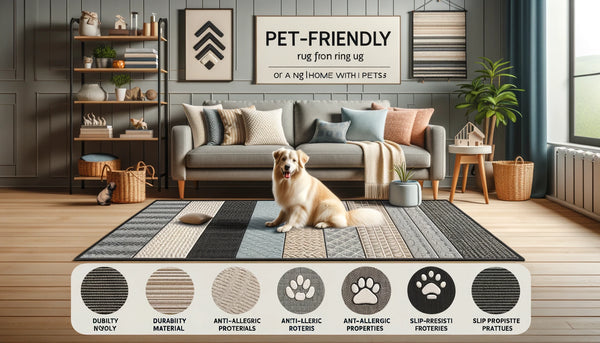
3. With a cat, pay special attention to loops and easily snagged threads
Scratching is normal cat behavior. If your cat likes to scratch rugs horizontally, a structure with large loops or loose threads can snag more easily.
In this case, opt for a cut pile, a dense surface, or a weave whose threads don't lift easily. Also, install a suitable scratching post near the area where the cat usually scratches. A horizontal support can be more effective than a vertical post if that's the orientation it prefers.
4. What rug material for a home with pets?
| Material / construction | Potential benefit | Things to watch out for |
|---|---|---|
| Polypropylene | Many models, often practical maintenance. | The backing and label determine the actual cleaning method. |
| Polyester | Softness and variety of colors. | Construction, density, and behavior with traffic. |
| Wool | Resilience and comfort. | Products compatible with wool and maintenance budget. |
| Jute / natural fibers | Natural texture and often low weave. | Sensitivity to moisture: less practical if frequent accidents. |
| Flat weave | Pet hair easy to see and vacuum. | Check thread retention if the cat scratches a lot. |
Synthetic material is not automatically "scratch-resistant" or "stain-resistant." The entire rug's construction matters, including density, backing, and finishes.
5. What color best conceals pet hair?
Choose a color close to the dominant fur if your priority is to make hair less visible between vacuumings. A black rug under a white dog immediately shows every hair; a cream rug under a black cat will do the opposite.
Mottled, vintage, or small patterns generally conceal everyday marks better than a very light or very dark solid color.
This choice remains aesthetic: it doesn't replace vacuuming. The goal is simply to achieve a more visually tolerant surface between cleanings.
6. What to do if the dog or cat urinates on the rug?
Act quickly. Start by absorbing fresh liquid with white paper or a white cloth, without rubbing. The more urine penetrates the backing and the floor, the harder the odor becomes to eliminate.
An old stain can also alter the dyes or layers of the rug. A product that masks the odor without removing residues doesn't necessarily solve the problem.
For cats, we have a specific guide: how to clean cat pee from a rug. It also explains when repeated accidents should lead to looking at the litter box or a possible medical cause.
7. What cleaning products to use in a home with pets?
First, follow the rug's instructions and the product's instructions. During cleaning, keep the pet away, prevent it from licking the product or the wet area, and allow it to dry completely before giving it access to the rug again.
Enzymatic cleaners are often used for organic residues. Check their compatibility with your rug, respect the dosage, and allow to dry according to the instructions. More product doesn't necessarily improve the result and can complicate rinsing or extraction.
Avoid adding essential oils to perfume the rug, especially in a household with cats. A pleasant scent for humans is not a criterion for animal safety.
8. How to effectively vacuum pet hair?
Vacuum more often rather than waiting for deep accumulation. In a household with multiple pets or during shedding season, several passes per week may be necessary depending on the amount of hair.
The attachment must remain compatible with the rug. A turbo brush can be effective on some surfaces, but not on all velvet piles. High-pile rugs or certain loops can be damaged by an aggressive brush roll.
If some hairs remain on the surface, a suitable textile accessory or a slightly damp rubber glove can help gather them without soaking the rug.

9. A stable rug is important with a running pet
A dog or cat's accelerations can move a light rug on a smooth floor. Check that the backing provides enough grip or use an underlay compatible with your flooring.
Curling corners should be corrected quickly, especially in high-traffic areas. A rug that slips is not only annoying: it can also cause household members to trip.
Avoid small, very light rugs in areas where your pet often runs. A larger, well-secured format is generally more stable.
10. A simple routine to keep the rug clean
- Vacuum regularly according to shedding.
- Wipe paws after muddy outings if necessary.
- Treat accidents immediately by absorbing without rubbing.
- Wash pet bedding to limit hair and odors around the rug.
- Inspect the underside of the rug after a significant accident.
- Rotate the rug if traffic always wears the same area.
For cleaning methods depending on the material and type of stain, consult our complete rug cleaning guide.
11. Mistakes to avoid with rugs and pets
- Choosing a very long shaggy rug when hair is already difficult to manage.
- Presenting a rug as "hypoallergenic" or "odor-free" without specific proof.
- Using a household product without checking its compatibility with the fiber and the presence of pets.
- Allowing the pet to walk on an area still wet after cleaning.
- Masking an odor instead of treating its source.
- Choosing a large, loose loop for a cat that scratches horizontally.
- Assuming a synthetic rug is automatically machine washable.
- Ignoring the underside of the rug after a urinary accident.
FAQ: Rugs with dogs or cats
What is the most practical rug with a dog?
A short-pile, dense, stable, and easy-to-spot-clean model is often the simplest. The choice also depends on the dog's size, yard access, and shedding.
What rug to choose with a scratching cat?
Avoid large loops and easily snagged threads. Prefer a dense surface and offer the cat a suitable scratching post, possibly horizontal.
Is jute suitable for pets?
It can be suitable if accidents are rare, but natural fibers are more sensitive to moisture. For a puppy in training or a cat that urinates outside the litter box, it's not the simplest choice.
What rug conceals pet hair?
A shade close to the fur color and a mottled pattern better conceal hair between vacuumings. This does not change the necessary cleaning frequency.
Can enzymatic cleaner be used?
Yes, if the product is compatible with your rug and used according to its instructions. Keep the pet away during treatment and until it is completely dry.
Is easy cleaning your priority? First look at the pile height, backing, and actual care method before choosing the color.
See the rug buying guideIn summary: with a dog or cat, prioritize a low-pile, dense, stable, and easy-to-clean rug. Match the color to their fur if you want to conceal hair, avoid large loops if your cat scratches, and address accidents quickly. The best rug isn't "pet-specific": it's the one whose construction truly suits your daily life.