


Can you put a rug on underfloor heating?
Yes, in many cases, but not with just any rug or any system. The determining factor is the total thermal resistance of what is above the underfloor heating: flooring, any underlay, and the rug. The more insulating this combination is, the more it slows down the passage of heat. Therefore, you must check the limits set by the manufacturer of the underfloor heating, the flooring, and the rug before installation.
1. Why can a rug hinder underfloor heating?
Underfloor heating works by transferring heat from the system to the surface, and then to the room. A rug adds an insulating layer. This is not necessarily dangerous or forbidden, but it can reduce the amount of heat transmitted and slow down the temperature rise.
A large, very thick rug, combined with an insulating underlay, blocks the heat flow more than a flat-woven rug without an underlay. The behavior also depends on the type of underfloor heating, its regulation, and the flooring directly above the system.
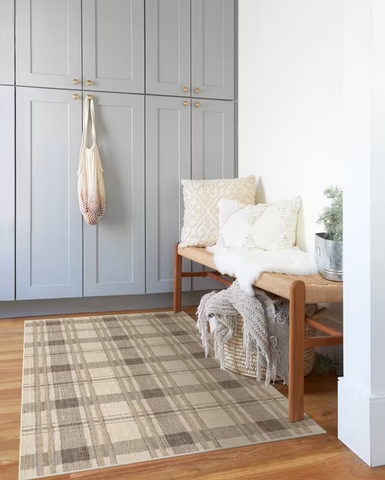
The correct reasoning is not "wool or synthetic?" but: what total thermal resistance does the rug + underlay + flooring combination create?
2. Tog, m²K/W: how to understand thermal resistance?
Tog is a unit used to express the thermal resistance of certain textiles and floor coverings. You may also find a value in m²K/W. The higher the value, the more the layer impedes heat transfer.
There is no single limit valid for all systems. Some manufacturers of electric underfloor heating set a limit around 1.5 tog for all layers above the heating, while some hydraulic systems can tolerate higher resistance, sometimes up to about 2.5 tog for rugs and underlays. Your manufacturer's value always takes precedence.
If the rug manufacturer does not provide any thermal data, ask them if the product is explicitly compatible with underfloor heating. The absence of a value does not automatically mean incompatibility, but it makes verification more difficult.
3. Which type of rug allows heat to pass best?
Conversely, a very thick shaggy rug, a multi-layered rug, or a model with insulating foam can further reduce heat output. This does not mean that all thick rugs are forbidden: you need to know their actual resistance and the system's limits.
Size also matters. A small rug in front of the sofa has less impact on the room than a model that covers almost the entire floor. If your underfloor heating is the primary heat source, the covered area should be considered in the thermal balance.
4. Wool, cotton, or synthetic: which material for underfloor heating?
The material alone is not sufficient to conclude. Thickness, density, backing, and construction are often more important than the fiber's name.
| Material | May be suitable? | To check |
|---|---|---|
| Wool | Yes, if the rug remains compatible and not excessively insulating | Thickness, density, and thermal value |
| Cotton | Often on flat-woven or lightweight rugs | Backing, stability, and maintenance |
| Polypropylene | Yes, depending on the product | Backing composition and permitted temperature |
| Polyester | Yes, depending on construction | Thickness and backing compatibility |
| Jute / sisal | Possible depending on product and system | Thermal resistance and backing behavior |
To compare materials beyond underfloor heating, consult our guide which material to choose for a living room rug.
5. Can I add an anti-slip underlay?
Yes, but the underlay becomes an additional thermal layer. Its resistance must therefore be included in the total calculation. Some models are explicitly designed for underfloor heating and are thinner; others, very felted or insulating, can greatly reduce heat transfer.
Chemical compatibility with the flooring also matters. Certain vinyl floors or finishes can react with certain rubbers or latex. The fact that an underlay is "anti-slip" therefore does not guarantee its thermal compatibility or its compatibility with the floor.
If your rug is already heavy and stable, check if an underlay is really necessary. Each added layer must have a clear function.
6. Electric or hydraulic underfloor heating: why does the difference matter?
Electric and hydraulic systems do not always have the same thermal resistance limits. Some electric systems require lower total resistance to prevent heat from getting trapped around the heating element. Hydraulic systems can sometimes tolerate more resistance, at the cost of reduced power transmitted to the room.
Therefore, do not transfer a recommendation found for one system to another. Precisely identify the brand and model of your heating system, then consult its manual or the installer.
Regulation is also important. A thermostat and, depending on the installation, a floor sensor allow for compliance with the temperatures specified by the system and the flooring.
7. The flooring under the rug may impose its own limit
Parquet, laminate, vinyl, tile, or stone do not have the same properties. Certain floor coverings, particularly wood and vinyl, may have a maximum surface temperature indicated by their manufacturer. A value near 27 °C is often encountered for some products, but again, this is not a rule to apply without verification.
The rug should not lead to adjusting settings beyond the flooring's limit simply because the room heats less. If adding a large rug significantly reduces the perceived heat, it is better to reconsider the rug or the system's balance rather than forcing the temperature.
On tile or stone, heat transfer is generally very good before adding a rug; a rug can therefore create a noticeable difference between the covered and uncovered areas.
8. How to lay a rug on underfloor heating?
- Identify the heating system and its thermal resistance limits.
- Check the flooring and its maximum permissible temperature.
- Choose a compatible rug, ideally with a thermal value or a clear indication from the manufacturer.
- Add the underlay only if necessary and if it is compatible with both heating and flooring.
- Avoid thick layering of rugs, foams, and insulating layers.
- Monitor the room's behavior after installation: heating time, temperature, and rug stability.

9. How to know if the rug is hindering heating too much?
If the area under the rug heats up much more slowly, if the room no longer reaches the desired temperature, or if the system runs for much longer, the rug may be too insulating for the installation.
A temperature difference between the covered and uncovered areas is normal to some extent. However, overheating, an abnormal odor, deformation of the flooring or the rug's backing warrants removing the rug and checking the manufacturer's recommendations.
Do not try to solve a lack of heat by significantly increasing the setpoint without knowing the limits of the floor and flooring.
10. Mistakes to avoid
- Choosing solely based on material: thickness and backing can completely change thermal resistance.
- Using a tog limit found online as a universal value: check your system.
- Stacking thick rugs + underlays: thermal resistances add up.
- Ignoring the flooring: parquet or vinyl may have their own temperature limits.
- Assuming an anti-slip rug is necessarily compatible: also check its composition and the floor.
- Covering almost the entire surface without checking available power: a large rug can reduce heat output.
- Significantly increasing the thermostat to compensate: respect the installation's limits.
FAQ: Rugs and underfloor heating
Can I put a thick rug on underfloor heating?
Sometimes, but only if its total thermal resistance remains within the system's limit. A thick rug generally reduces heat transfer more than a flat-woven one.
What is the best rug for underfloor heating?
The simplest is a relatively thin, short-pile or flat-woven rug, explicitly compatible with the system and flooring.
Is wool compatible with underfloor heating?
Yes, in many cases. However, compatibility depends on the rug's thickness and thermal resistance, not just the wool fiber.
Should I remove the rug in winter?
Not if the rug is compatible and the system heats correctly. If the room loses too much power, reconsider its thickness, size, or underlay.
What tog value should not be exceeded?
There is no single value. Some electric systems require a maximum of about 1.5 tog above the heating, while some hydraulic systems allow more. Your system's manual is the reference.
A rug can perfectly coexist with underfloor heating if its construction respects the thermal limits of your installation.
Discover living room rugsTo choose safely, remember three checks: rug's thermal resistance, underlay's compatibility, and system/flooring limits. A thin and properly documented model generally simplifies the choice and allows the heating to work more efficiently.