


How to place a rug in a living room to connect the sofa, armchairs, and coffee table?
In a living room, a rug works best when it visually connects the seating area instead of remaining isolated under the coffee table. In most configurations, rest at least the front legs of the sofa and armchairs on the rug. Then, orient the rug along the same axis as the furniture group and maintain clear pathways around it.
This page intentionally focuses on rug placement. For overall layout, colors, lighting, and walls, please refer to our guide How to decorate your living room.
1. The simplest rule: the rug must belong to the furniture group
A rug placed alone in the middle of the living room often gives the impression of being too small, even if it's beautiful. The visual flow becomes more natural when the rug visually touches the sofa and other seating. This is why placement with the front legs of the seating on the rug is an excellent starting point.
In a large room, you can go further and place the entire sofa and armchairs on a generous rug. In a compact space, the rug can remain partially under the furniture, provided there's a clear connection between them.
2. Three ways to place a rug in a living room
3. What size rug to choose for the living room?
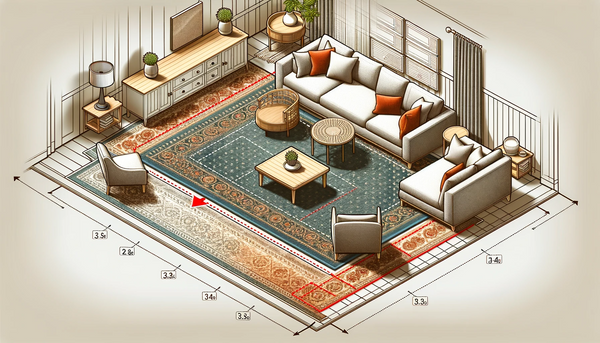
The size depends primarily on the width of the furniture group, not just the square footage of the room. Measure the sofa, armchairs, coffee table, and the space you want to bring together. The rug generally benefits from visually extending beyond the sofa on the sides rather than being narrower than it.
| Configuration | Commonly considered format | What to check |
|---|---|---|
| Small living room | Approximately 120 × 170 to 160 × 230 cm | Ensure the rug visually connects with the sofa without blocking pathways. |
| Standard living room | Approximately 160 × 230 to 200 × 290 cm | Ensure the front legs of the main seating can rest on it. |
| Large seating area | 200 × 290 cm and above | Ensure the rug encompasses the furniture group instead of floating in the center. |
These dimensions are guidelines, not universal rules. To go further, use our dedicated guide What size rug for a living room? or browse large living room rugs.
4. Which way to orient the rug?
In most rectangular living rooms, the rug's orientation follows that of the main group: a long sofa and a rectangular coffee table often call for a rug placed on the same axis. This continuity avoids an impression of rotation or conflict between the furniture lines.
In a very long room, the rug can also serve to break up the "corridor" effect by only defining the living room area. In a large open-plan room, don't necessarily try to center the rug relative to the four walls: center it relative to the seating area.
5. How to place a rug in a small living room?
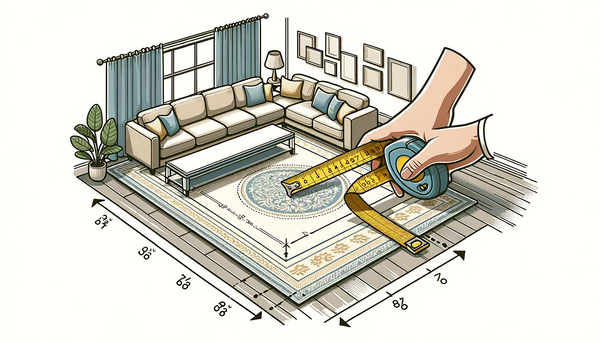
A small living room doesn't automatically require a small rug. A format that's too small can multiply visual boundaries and make each piece of furniture seem independent. A rug large enough to slip under the front legs of the sofa can, on the contrary, unify the room.
Prioritize useful pathways and avoid forcing a very large format if it clashes with a door or a fixed piece of furniture. For the overall layout, also find our tips for decorating a modern small living room.
6. How to place a rug with a corner sofa?
A corner sofa already forms a very clear zone. The rug should complement it rather than appear tiny in the center of the "L." A format wide enough to extend under the front parts of both sections generally creates a more cohesive ensemble.
The chaise lounge can rest partially or entirely on the rug depending on the dimensions. The important point is to maintain a clear relationship between the seating, coffee table, and rug. Our guide Which rug to choose for a corner sofa? details specific cases.
7. What about with a round rug?
A round rug does not follow the same axial logic as a rectangular one. It works particularly well to soften a very linear composition, highlight a round table, or create a small conversation area. Its diameter must nevertheless be proportionate to the furniture: a circle that's too small quickly looks like a simple medallion under the coffee table.
For different possible placements, consult Round rug in the living room: where to place it?.
8. The most common placement mistakes
- Choosing the rug before measuring: dimensions on a product sheet are difficult to visualize without ground markers.
- Placing it only under the coffee table: if the rug is too small, it can seem detached from the sofa.
- Centering it on the room instead of the living area: in an open space, the furniture zone matters more than the walls.
- Blocking pathways: an edge placed exactly in a pathway can become inconvenient.
- Multiplying small gaps around it: aim for a regular and consistent visual margin.
- Ignoring stability: on a smooth floor, check that the rug remains stable and use an appropriate non-slip solution if necessary.
FAQ: How to put a rug in a living room?
Should the sofa be on the rug?
Not necessarily entirely. In many living rooms, placing the front two feet of the sofa on the rug is enough to connect the elements. In a large space, the sofa can rest entirely on it.
Should the rug be centered under the coffee table?
The coffee table can be centered on the rug, but the rug should primarily be centered relative to the seating group. The relationship with the sofa and armchairs is more important than the room's geometric center.
Can a rug extend behind the sofa?
Yes. When the sofa rests entirely on a large rug, leaving a margin behind it can create a generous and cohesive composition, provided the format remains proportionate to the room.
Which rug to choose for a neutral living room?
A beige, textured, or slightly contrasting rug is easy to integrate. A beige rug can serve as a calm base; a bolder shade or pattern can become the focal point.
How do I know if my rug is too small?
If no seating visually touches the rug and it seems to float alone under the coffee table, try marking out a larger format on the floor. Comparing them will immediately show if the group becomes more cohesive.
Placement becomes much simpler with the right format. Measure your sofa–armchairs–coffee table group, then compare the available dimensions.
Discover living room rugsTo properly place a rug in a living room, first consider the relationship between the furniture: the rug should serve as a common base. Measure, mark the dimensions on the floor, and then choose the color or style. This inversion of the decision-making order avoids most proportion errors.