


Small Living Room: Prioritize Traffic Flow Before Decorating
To furnish a small living room, start by defining pathways, choosing a proportioned sofa, and limiting the number of floor-standing furniture pieces. Only then should you add storage, lighting, rugs, and decorations. A small living room rarely appears cluttered because it lacks square footage; it becomes cluttered mainly when furniture blocks traffic, serves multiple functions, or is illogically placed against walls.
The goal is not to make the small space "disappear." Instead, it's about creating a livable room where you can sit, move around, store things, and entertain without constantly shifting furniture. Here's a complete method to achieve this balance.
1. Measure the living room and draw pathways before furnishing
Note the length and width of the room, as well as the location of doors, windows, radiators, outlets, recesses, and openings to other spaces. These "fixed" elements determine the layout more than the total stated area.
Next, measure your existing furniture. A 220 cm sofa doesn't just occupy 220 cm of wall space: you also need to be able to walk around it, open a nearby door, and maintain a comfortable distance from the coffee table. Test this with masking tape on the floor to visualize the actual footprint.
Finally, identify the main path: from the living room entrance to the sofa, window, kitchen, or balcony. This path should remain clear. If you have to go around a coffee table, walk behind a chair, or skirt around furniture at an angle every time you move, the living room will feel smaller than it is.
2. Which sofa to choose for a small living room?
The sofa is usually the most voluminous piece of furniture. Choose it first and size everything else around it. A compact two or three-seater model is often simpler than a large corner sofa, but the shape of the room can reverse this choice: in some living rooms, a small corner sofa fits better against a wall and replaces the need for an additional armchair.
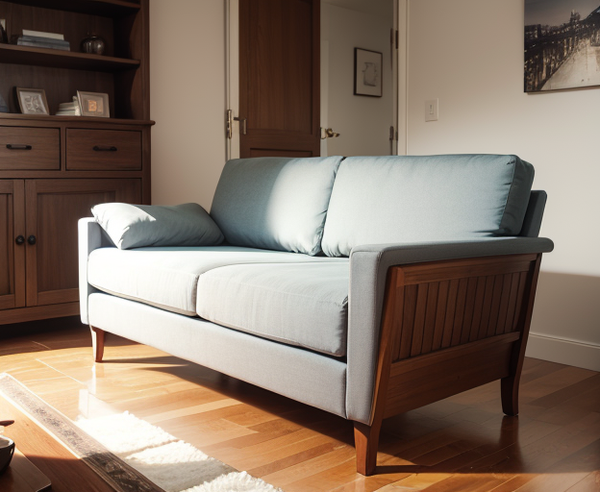
Pay particular attention to depth. Two sofas of the same width can occupy very different volumes. Slim armrests and a less massive backrest visually free up space without necessarily reducing the number of seats.
Visible legs create a sense of lightness because part of the floor remains visible under the sofa. This is not an aesthetic requirement: a storage sofa or one with built-in storage can be more relevant if you truly lack storage space.
Avoid buying a "miniature" sofa just because the room is small. If the living room is your primary living space, a comfortable, properly proportioned sofa and fewer secondary furniture pieces are better than a too-small sofa surrounded by several accent chairs.
3. How much space to leave for circulation?
There is no universal measurement for all living rooms, as not all passages have the same importance. A daily path between two rooms deserves more space than occasional access behind an armchair. The goal is that two pieces of furniture do not create an obvious bottleneck.
To test your plan, actually move around the room: enter with a bag, open the window, sit down, pull a chair back, place a tray on the coffee table. If every action requires turning or moving an object, the layout is too dense.
Also, avoid sharp corners directly in a pathway. A round or oval coffee table can be more pleasant than a rectangle in a tight space, not because it magically "enlarges" the living room, but because it reduces the corners to navigate around.
4. Choose fewer furniture pieces, but with truly useful dimensions
Multifunctionality is useful when it meets a real need: a storage bench, a coffee table with storage, a sofa bed if the living room regularly hosts guests. It becomes counterproductive when a convertible piece of furniture is heavier, deeper, or more difficult to use than two simple functions.
Glass or transparent acrylic can visually lighten a table, but they don't free up any inches. Treat them as an aesthetic choice, not a space-saving solution.
5. How to create storage without filling the floor?
First, use the walls. Shallow shelves, a wall-mounted unit, or a tall bookcase utilize vertical space and leave more floor visible. This doesn't mean you need to cover every wall: concentrate storage in one or two areas to keep surfaces uncluttered.
Combine open and closed storage. Open shelves are practical for books and decorative objects, but a small room filled with dozens of visible items can appear more cluttered. Closed fronts hide cables, papers, games, and everyday accessories.
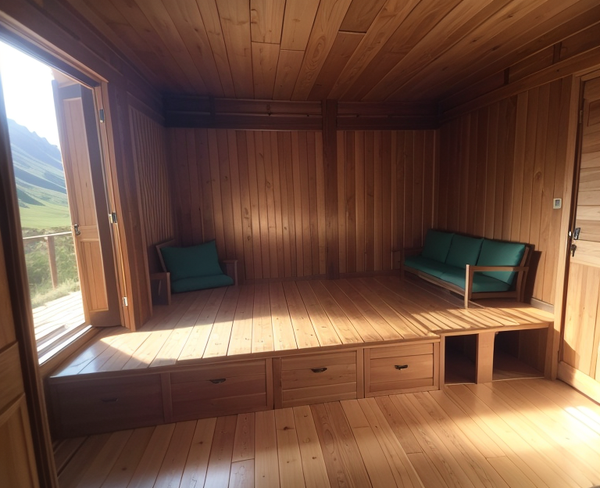
Utilize lost volumes: under a sofa if the model allows, behind a door, in a niche, or high above a piece of furniture. Before adding a new chest of drawers, ask yourself if existing storage can be better organized.
6. Light: Multiply uses rather than lamps
Preserve natural light by avoiding placing tall furniture in front of a window. Curtains that can be drawn wide open allow more light to enter during the day.
For artificial lighting, combine general lighting with one or two sources adapted to specific uses: a reading lamp near the sofa, a wall light or floor lamp that indirectly illuminates a wall. In a small room, four table lamps can take up more space than they provide comfort.
A mirror can reflect a window or a bright area, but its placement should be chosen for what it reflects. Facing a cluttered wall or a dark hallway, it can visually double what you were trying to soften.
7. What rug for a small living room?
The rug should connect the group of furniture rather than float alone under the coffee table. A small living room does not automatically require a small rug. A too-small size multiplies boundaries on the floor and can visually fragment the room.
In many configurations, having at least the front legs of the sofa rest on the rug creates a more cohesive ensemble. Measure the sofa-coffee table-armchair area before choosing. Our guide how to place a rug in a living room details placement configurations.
For color, a light rug can maintain a bright ambiance, but it doesn't automatically enlarge the room. A darker rug, conversely, can effectively define the living area in an open space. The choice depends on the overall palette and the desired level of contrast.
8. Should you always use light colors?
No. Light walls often reflect more light and provide an easy base, but a small living room can perfectly accommodate green, blue, terracotta, or a darker accent wall. Consistency matters more than banning dark colors.
Instead, limit the number of major visual breaks. A palette of two or three color families repeated on the sofa, rug, curtains, and a few objects creates a calmer visual flow.
A pattern can become the focal point of the living room, especially on the rug or cushions. If several surfaces are already very graphic, keep the others simpler to prevent each element from demanding attention.
9. How to furnish a small living room open to the kitchen or dining room?
In an open-plan room, the living room doesn't need partitions to exist. Use the sofa's orientation, a rug, and lighting to create an identifiable zone. The back of the sofa, for example, can mark the boundary with the dining room, provided it doesn't block the pathway.
Avoid multiplying small rugs to "define" each function in an already reduced space. A properly sized rug under the living area and continuous flooring elsewhere are often sufficient.
Also, maintain material consistency between zones. You can change the accent color between the living room and kitchen, but repeating wood, metal, or a common shade helps the space remain unified.
If you prefer a more contemporary style, the article small modern living room expands on this angle without duplicating this general guide.
10. Mistakes that clutter a small living room the most
- Buying before measuring: a photo of a piece of furniture doesn't show its bulk in your circulation path.
- Pushing all furniture against the walls: this isn't always the most functional arrangement.
- Accumulating small furniture: several side tables and poufs can take up more floor space than one well-sized table.
- Choosing a rug that's too small: it fragments the seating arrangement.
- Multiplying visible objects: reserve closed storage for everyday items.
- Blocking natural light: avoid tall furniture in front of windows.
- Confusing minimalism with discomfort: keep the functions you actually need.
- Copying a plan seen in a photo: adapt it to the doors, windows, and uses of your own room.
FAQ: Furnishing a Small Living Room
What sofa for a 10 to 15 m² living room?
Measure the width, but also the depth and pathways. A compact two or three-seater sofa is often suitable, but a small corner sofa can be relevant if it replaces several separate seats.
Should the sofa be against the wall?
Not necessarily. In an open room, the sofa can define the living area. In a very compact room, the wall is often practical for preserving circulation.
What type of coffee table to choose?
Choose it according to the space remaining after the sofa. A round shape, a nesting table, or a lift-top model can be more practical if the center of the room needs to remain flexible.
What rug to enlarge a small living room?
Above all, choose a rug that is correctly sized to connect the furniture. A light shade can maintain brightness, but size and placement have more impact on visual coherence.
How to create storage without cluttering?
Use walls, shallow closed furniture, and existing volumes, such as under a sofa or in a niche, before adding floor-standing furniture.
A rug can help structure a small living room without adding furniture. First, measure your seating group, then choose a size that truly connects the space.
Discover living room rugsTo succeed with a small living room, start with what isn't visible in decor photos: measurements, pathways, and uses. Once the sofa and circulation are well placed, storage, light, rugs, and colors become much simpler to choose. A compact living room works well when it contains fewer elements, but each has a real reason for being there.